 Auto
Auto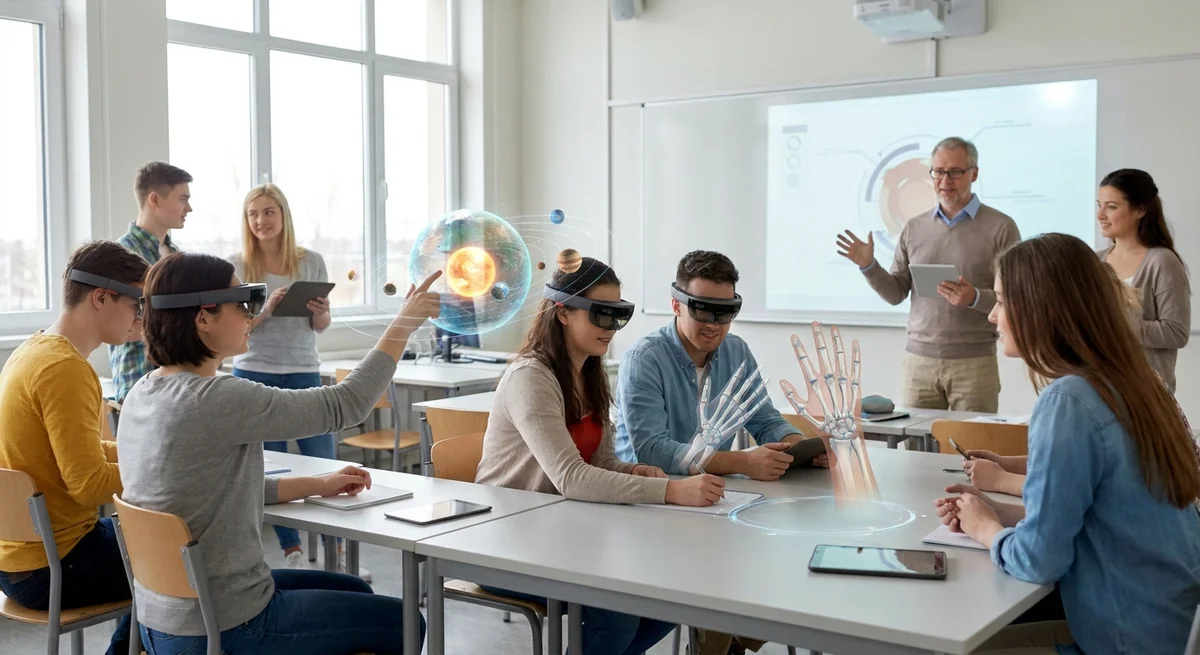
The Role of Augmented Reality in Education: Enhancing Learning Experiences
Augmented Reality (AR) is emerging as a transformative educational technology, overlaying digital content onto the physical classroom to create immersive learning environments. AR systems use devices like tablets, smartphones, or AR glasses to blend virtual 3D models, animations, or information with real-world objects. As one recent study notes, AR is “revolutionising education by integrating virtual elements into physical environments, enhancing interactivity and participation in learning processes” . By making abstract concepts tangible and engaging, AR has the potential to deepen understanding, spark curiosity, and improve retention across subjects. This article explores how AR tools are being used in classrooms, the benefits of visual, immersive learning, and real-world applications of AR. We also highlight success stories where schools and universities have adopted AR to boost student engagement and learning outcomes.
Innovative AR Tools in Classrooms
Educators have a growing toolbox of AR applications and devices to bring lessons to life. Many AR tools simply require a smartphone or tablet, making them accessible and easy to integrate. For example, [Edutopia] notes that with AR apps, “objects, artifacts, or media appear to be in the room,” and students can walk around and manipulate them to learn more (www.edutopia.org). In one teacher’s experience, students were more engaged when they could create AR experiences: “students’ engagement increases when they create experiences in AR to demonstrate their understanding,” and “they want to dive into the content” (www.edutopia.org). Below are some leading AR tools and apps used in classrooms today:
- Merge Cube – A foam cube that students hold to explore 3D objects inside (with a smartphone ). Using the Merge Cube with free apps, students can, for instance, “explore the water cycle, view fossils, examine rocks and gemstones, experiment with simple machines, and more.” The cube lets students virtually hold artifacts and objects, giving them an interactive, hands-on view of otherwise abstract items (www.edutopia.org). For example, a lesson on astronomy might let students hand-hold a miniature 3D model of the solar system, examining planet orbits up close.
- CoSpaces Edu – A platform where students build their own AR or VR content. Learners can create virtual scenes, import 360° photos, and even code interactions. Projects can be viewed with or without the Merge Cube. This app encourages creativity and technical skills: students “can add audio, code characters and objects, and upload their own 360-degree photos or images into their project” (www.edutopia.org). For example, English classes might use CoSpaces Edu to create interactive story worlds that classmates can explore.
- Assemblr – A web and mobile app for exploring and creating 3D models. Assemblr has libraries of AR content in topics like biology (e.g. 3D animals) and mathematics (e.g. geometric shapes). Teachers or students can place digital 3D objects in a room or draw new models. As the developer describes, Assemblr “empowers students to be creators of content” so they can, for instance, explore 3D models of the human heart or build an interactive math graph (www.edutopia.org).
- Quiver Masks – An AR app that lets young students make and wear character masks. After creating paper masks (for example, animal faces or storybook characters), students use the app to scan them and transform into those characters in real time. This can be used in kindergarten or literature classes to act out stories – e.g. retelling “The Three Little Pigs” by wearing an animated pig mask (www.edutopia.org).
- Narrator AR (by Narrator’s Voice) – For early writing practice, this app animates letters and words. As Edutopia notes, Narrator AR “gives students a place to practice their handwriting” by launching letters off the virtual page, making penmanship more engaging (www.edutopia.org). Young learners can trace letters and see animations, reinforcing correct writing in a fun way.
- GeoGebra AR – An extension of the popular GeoGebra math software, this tool lets students view 3D graphs and geometry using AR. For instance, plotting a quadratic function in GeoGebra AR appears as a floating 3D parabola in the room. This helps students visualize math that normally stays on paper. One study specifically used GeoGebra AR to teach functions and noted that students using it showed greater spatial visualization and task performance compared to traditional teaching (www.mdpi.com).
Beyond apps, some schools experiment with AR glasses and headsets. Devices like Microsoft HoloLens or Magic Leap (though pricier) can overlay interactive holograms. However, many AR classroom activities are already possible by simply projecting the world through a phone or tablet screen.
Using these tools, teachers can create immersive lesson plans such as:
- Virtual field trips: Paint 360° scenes of historical landmarks or natural habitats and let students explore them by moving around.
- Gamified learning: Turn quizzes into AR puzzles or scavenger hunts that reveal clues in the classroom.
- Interactive textbooks: Use marker-based AR where pointing a device at a diagram triggers animations (e.g. an AR periodic table that shows elements’ structures).
Each tool is meant to engage students actively. Rather than passively reading facts, students physically interact with content. As one article observes, AR in the classroom allows learners to walk around digital objects and study details up close (www.nature.com), thereby making lessons more dynamic.
Benefits of Visual and Immersive Learning
Augmented reality leverages the power of visual learning and interactivity, tapping into how the brain best absorbs and retains information. Multiple studies confirm that visual aids and active learning can significantly enhance comprehension and memory. AR builds on this by superimposing rich multimedia on real-world views, creating a multi-sensory experience. Some key benefits include:
- Enhanced Engagement: AR lessons are inherently novel and fun, which captures student interest. Research consistently finds that when lessons incorporate AR, students report higher attention and excitement. For example, one mixed-method study noted that AR lessons led to “positive learning outcomes” and heightened engagement among both students and teachers (www.nature.com). In STEM classrooms, AR has been shown to “upgrade engagement, motivation, and participation” as learners can manipulate virtual elements of their lesson (www.nature.com). The hands-on, game-like quality of AR often makes students more eager to participate.
- Improved Understanding and Retention: By visualizing the unseen aspects of a topic, AR helps learners form stronger mental models. Education experts highlight that AR can make “complex concepts” concrete, aiding comprehension【9†L19-L25, L37-L39】. For instance, overlaying a 3D model of a cell on a desk instantly clarifies its structure far better than a flat textbook image. Learning science through 3D content has been shown in parallel research to improve students’ ability to recall information (one source notes that interacting with 3D content can lead to a 70% higher retention rate than passive methods) (moldstud.com). In an engineering class, simulations created with AR toolkits solidified students’ spatial understanding – they retained mechanical concepts better when they could manipulate models in AR (www.mdpi.com).
- Active Learning and Construction of Knowledge: AR encourages student-driven investigation. Rather than passively reading text, learners “get closer” to virtual objects and explore them from different angles (www.edutopia.org). This active approach aligns with educational theories that learning by doing fosters deeper mastery. For example, when students build their own AR projects (like creating a virtual museum exhibit), they must synthesize information and think critically about how to present it. One study on math education noted that AR tools helped students develop spatial intelligence by letting them “interact with real and/or virtual objects,” thus improving visualization and problem-solving skills (www.mdpi.com).
- Concept Visualization: Abstract or microscopic processes become visible. A student cannot normally see inside a chemical reaction or the architecture of a molecule. With AR, the chemical bonds and reactions can be visualized in 3D. As one high school chemistry study explains, AR allows learners to “enter the submicroscopic world” – they can watch virtual atoms rearrange and understand a second-degree reaction in real time (www.mdpi.com). This bridges the gap between theoretical ideas and intuition, which improves learning effectiveness.
- Safe Simulations: AR provides a controlled environment to try experiments safely. For instance, biology classes can dissect virtual frogs, chemistry labs can mix virtual reagents (avoiding safety hazards), and physics experiments can simulate infinity falls without breaking any eggs. This lets students explore freely, make mistakes, and learn without real-world consequences.
- Personalized Learning: Interactive AR can adapt to individual students. For example, an AR spelling app can advance only as the child correctly forms letters, or a geometry AR game can increase in complexity for advanced learners. This flexibility, combined with instant visual feedback, tailors the pace to each student’s needs.
In summary, visual learning strategies supported by AR help make lessons more interactive, memorable, and personalized. These effects are borne out by multiple studies showing AR’s positive role in learning outcomes (www.nature.com) (www.nature.com).
Real-World Applications of AR Across Subjects
AR is not limited to a single subject; creative educators are applying it across the curriculum:
- Science and STEM: AR is particularly useful for science classes, where many concepts are three-dimensional or otherwise invisible. For example, in physics students can use AR apps to visualize electric fields or visualize a magnetic field around a wire by overlaying arrows of force in the lab. In biology, apps can display detailed 3D models of the human heart, brain, or a plant cell right on the desk. One innovative chemistry system lets students mix chemicals by placing AR-coded cards on the camera – the screen then shows the reaction at the molecular level. These AR simulations help students grasp “macroscopic to submicroscopic changes” in reactions (www.mdpi.com). Scientific reports confirm that using AR simulations in science labs can significantly improve test scores and concept retention (www.nature.com).
- Mathematics: Geometry and visualization-heavy topics benefit from AR overlays. Platforms like GeoGebra AR allow students to plot real-time graphs of functions that appear as floating surfaces or manipulate 3D geometric shapes (like cubes and pyramids) in their actual environment. This turns algebra and geometry into a spatial game: one study specifically found that students using an AR app for math functions showed clear improvements in spatial reasoning and problem-solving (www.mdpi.com). Learners could “rotate” and “explore” graphs from all sides, a technique hard to achieve on paper.
- Language and Literacy: AR is enhancing languages in creative ways. In English and foreign language classrooms, AR picture books can come alive: pointing a tablet at a page may animate characters or play audio narration. For early literacy, apps like Narrator AR engage young writers by animating letters and words. In advanced language study, AR games and apps can immerse learners in cultural scenarios. For example, a recent project called EULALIA developed an AR app for learning a foreign language. In a study trial, students using this AR language app showed a “statistically significant increase in cultural knowledge” and reported better learning progression compared to traditional methods (slejournal.springeropen.com).
- Social Studies and History: Imagine students standing in front of a plain classroom wall and seeing the Battle of Gettysburg unfold via AR projections. Several history curricula now include AR components: historical sites and artifacts are rendered in 3D overlays, time-travel experiences, or interactive timelines. AR field trip apps can transport a class to the Roman Colosseum or inside the surface of Mars. By comparing past and present visually, students gain empathy and context that textbooks alone can’t convey.
- Arts and Literature: In art classes, AR apps let students view famous paintings with annotations hovering over them, explaining style and symbolism. Literature teachers use AR to animate scenes or poems; for example, an AR app might bring a scene from Shakespeare to life. These immersive narratives make stories “stick” with readers: traditional literature lessons become interactive experiences, boosting comprehension and enjoyment.
- Vocational and Technical Training: Beyond K-12, AR is widely used in vocational education. Medical schools use AR (e.g. Microsoft HoloLens projecting organs onto mannequins) to train anatomy. Technical schools use AR manuals to guide students through machinery repairs. Even in business and management education, AR case studies simulate real work scenarios, allowing learners to practice skills in a controlled environment.
Each of these applications demonstrates AR’s cross-disciplinary potential. The key is that AR adds layers of context and visualization. As researchers summarize: AR can overlay “digitized” objects onto the real world, allowing students to observe details of complex subjects in new ways (www.nature.com). When students can physically walk around a 3D model of, say, the solar system or a medieval cathedral, the lessons become memorable and engaging.
Future Outlook and Challenges
The future of AR in education looks promising. Technology is rapidly improving (with 5G, better AR headsets, and accessible authoring tools), and more schools are experimenting with it. However, several challenges remain. AR requires compatible devices and sometimes high-quality cameras or sensors. As reported by educators, the cost of devices, software, and teacher training can be a barrier, especially for underfunded schools (elearningindustry.com). Further, teachers need training to integrate AR effectively – without proper guidance, exciting AR tech might be underutilized or distract from learning goals (elearningindustry.com). In one university review, experts advised that educators must carefully decide when and how to use AR; overusing AR or deploying it without support can hinder rather than help (news.ku.edu).
Despite these hurdles, the potential benefits continue to drive adoption. As AR tools become more affordable and user-friendly, analysts predict AR will become mainstream in classrooms. Already, numerous pilot programs show that even simple AR interventions can produce significant gains in engagement. For example, a comprehensive study in Malaysian primary schools found that students overwhelmingly preferred learning with AR. These children could interact with 3D alphabets and flashcards, and the study concluded AR was “an engaging and helpful tool for learning purposes” (www.mdpi.com). Another experiment in Kenya comparing AR apps to traditional classroom videos found better learning outcomes through AR, leading teachers to recommend AR as an educational aid (www.mdpi.com). (On the other hand, some research notes that novelty wears off if not well-integrated – in one Kansas study, students felt more engaged with AR but ultimately performed worse on an immediate test than peers who studied from video (news.ku.edu), suggesting educators should blend AR judiciously.)
Overall, institutions that succeed with AR often start small: they pilot one AR unit or bring in a tablet cart. They track metrics like student time-on-task, quiz scores, and feedback. Many report that AR lessons noticeably increased participation: students who were usually shy became eager to interact with 3D content. Longer-term studies are emerging. For example, a recent meta-analysis of AR education research found consistent trends: AR generally leads to positive student attitudes and engagement, and in many cases improved achievement over conventional instruction (www.nature.com) (www.nature.com).
Conclusion
Augmented Reality is reshaping education by blending the virtual and real to create interactive, student-centered learning experiences. By enabling students to visualize invisible ideas, manipulate virtual objects by hand, and explore subject matter in an embodied way, AR addresses key aspects of how people learn best. As we have seen, AR tools – from simple apps on a tablet to advanced AR headsets – are being used in science, math, history, language, and beyond. Studies consistently highlight AR’s benefits: increased motivation, deeper understanding, and better retention of material (www.nature.com) (www.nature.com).
At the same time, success depends on thoughtful implementation. Educators should align AR activities with clear learning goals, ensure all students have access to the technology, and provide sufficient teacher support. When done well, the payoff is significant. Schools that have embraced AR report that lessons become richer and more exciting: abstract theories suddenly have concrete form, and passive students transform into active explorers.
Looking ahead, as AR becomes more ubiquitous and affordable, we can expect it to become an integral part of mainstream teaching. Imagine a future classroom where every student can summon an entire solar system with a tablet or tour the inside of Shakespeare’s Globe in augmented reality. Such immersive experiences are no longer science fiction – they are happening now, and early evidence suggests they are making education more engaging, memorable, and effective. The early success stories and research findings give every reason to continue exploring AR as a powerful tool for enhancing learning.